
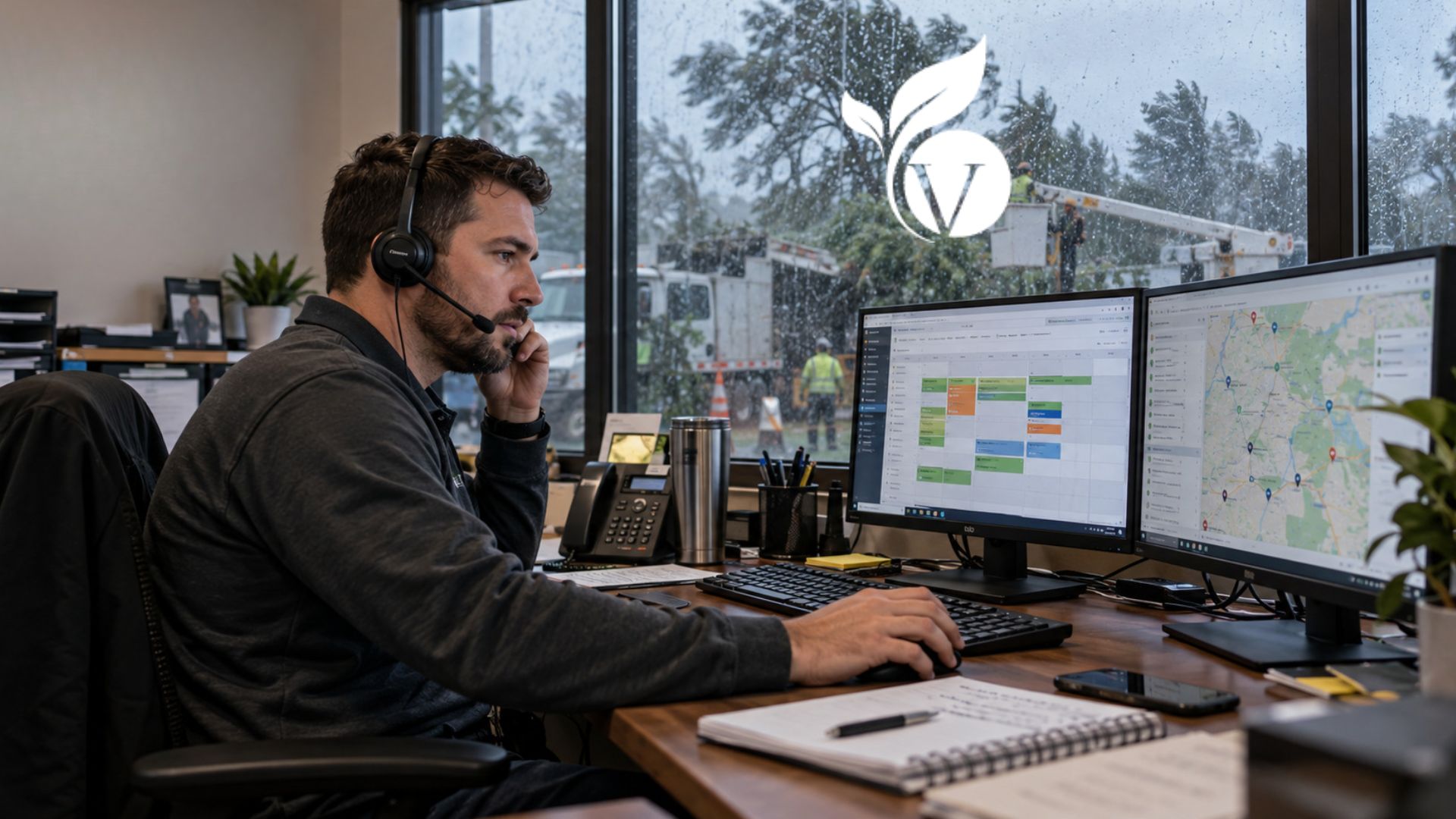
When a storm rolls through, your phone doesn't ring. It explodes. Homeowners with a tree on their roof don't wait around. They call whoever picks up first. If your back office support service can't handle that spike, in scheduling, in customer calls, in the billing that piles up right behind the crew work, you lose jobs to the company down the street that answered faster. If you already know your office needs more capacity before the next storm hits, contact our team and we'll walk you through what that looks like. If you want to understand why this specific moment matters so much first, keep reading.

What Happens to Your Back Office When Storm Season Hits?
Everything that was manageable in a normal week suddenly isn't. Call volume can spike fast, often within hours of a storm passing through your service area, and every one of those calls is someone who needs a fast answer, not a voicemail. Scheduling gets harder because emergency jobs have to be slotted in around whatever was already on the calendar. And behind all of that, invoicing and insurance documentation for storm-related work starts piling up right when your office has the least bandwidth to handle it.
Hurricane season is one clear example, but it's not the only one. Severe spring storms, derechos, and winter ice events can create the same kind of spike anywhere in the country, not just along the Atlantic and Gulf coasts. The Atlantic hurricane season runs from June 1 through November 30, according to NOAA, but plenty of tree service companies deal with this same problem outside that window entirely.
What Is a Back Office Support Service, and What Does It Actually Cover?
A back office support service is a team that handles the administrative side of running a tree care business, scheduling, customer calls, accounting, payroll, and HR, so your crews can stay focused on the trees instead of the paperwork. For a tree care company specifically, that usually breaks down into a few core pieces: answering and routing calls, booking and adjusting appointments around crew availability, keeping the books current with tools like QuickBooks, and handling the HR tasks that come with growing a field crew.
The value of a dedicated back office support service, rather than piecing it together in-house, is that the capacity is already built to flex. It doesn't disappear the moment call volume triples.
Why Do Tree Care Companies Struggle to Scale Their Back Office During Storm Season?
Because hiring local administrative staff for a temporary surge is rarely practical. Local hiring takes weeks you don't have when a storm is already moving through, and once the surge passes, you're either overstaffed or letting people go, neither of which is good for the business or for the people you hired. Training someone on your specific scheduling software and customer service approach takes real time too, time that's in shortest supply exactly when you need help most.
That mismatch, between when you need capacity and how long it takes to build it locally, is the core problem a specialized back office support service is built to solve.
What's the Difference Between a Generalist BPO and a Specialized Back Office Support Service?
A generalist BPO typically answers phones and processes data. A back office support service built specifically for tree care understands why a caller mentioning a tree down on a power line needs to be escalated immediately, not queued behind a routine pruning request, and why insurance documentation for storm damage has to be handled with more care than a standard invoice. That industry-specific judgment is what separates "someone answering the phone" from a team that actually protects your business during the moments that matter most.
If you want the fuller picture of why tree care companies are turning to back office BPO services in general, not just for storm season but as a structural shift in how the industry handles staffing, our earlier piece on how back office BPO services solve the tree care staffing shortage covers that in more depth.
How Do You Choose the Right Back Office Service Providers for Storm Season Readiness?
Start by asking how a provider actually handles a sudden spike in volume, not just their normal day-to-day capacity. Worth checking:
- Real experience with tree care or field service businesses specifically, not just general admin support
- The ability to scale coverage up quickly without a lengthy onboarding delay
- Bilingual coverage, which helps whenever crews or customers prefer communicating in Spanish
- A clear process for handling insurance documentation and storm-related invoicing, not just standard billing
Among back office service providers, the ones worth working with can show you they've actually planned for this kind of surge, not just promised to handle it.

How Does Tree Care Office's Nearshore Model Support Companies Through Storm Season?
Tree Care Office is backed by Vinali Group's nearshore delivery model, which is what makes that kind of surge capacity possible in the first place. Our teams work out of Colombia and Honduras, overlapping with U.S. business hours, so when call volume spikes during a storm, there's already a trained, bilingual team that can flex without the weeks-long ramp-up a local hire would need. That's the difference between scrambling every storm season and having a back office that's actually built to handle one.
If your office isn't ready for the next spike, contact our team and we'll walk you through what a dedicated back office support service could look like for your business.
Disclaimer: Information referenced in this article, including hurricane season dates, comes from NOAA and other publicly available sources considered reliable at the time of publication and is provided for general informational purposes only.